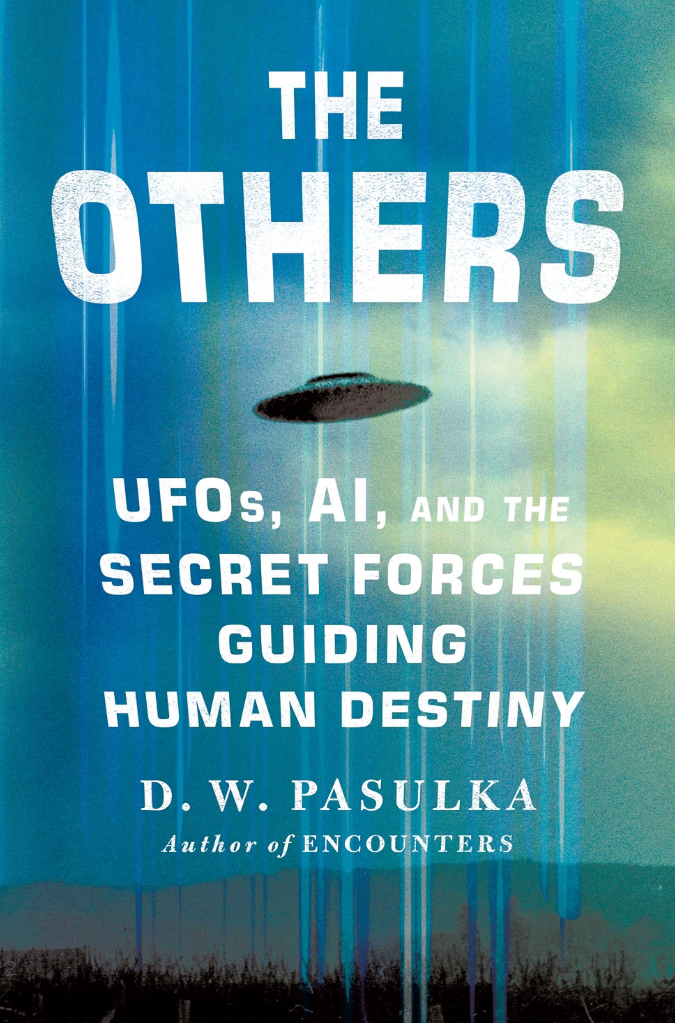
Some books ask you to believe something.
This one asks you to notice something.
The Others: UFOs, AI, and the Secret Forces Guiding Human Destiny isn’t really about flying saucers, and it isn’t really about chatbots. It’s about what happens to the inner life of human beings when two kinds of “nonhuman intelligence” show up at the same moment in history.
And it’s about whether we’ll still recognize ourselves when they do.
What This Book Actually Is
At its core, this is a work of spiritual intellectual history wrapped inside a field journal.
Pasulka, a religious studies professor and the author of American Cosmic, follows a small group of mostly Catholic thinkers who, decades ago, seemed to see our present coming:
- René Girard, who showed how imitation and envy drive crowds to single out a scapegoat
- Marshall McLuhan, who argued that our media quietly rewire how we perceive reality
- Pierre Teilhard de Chardin, the silenced Jesuit priest who imagined a planetary “thinking layer” he called the noosphere
- Arthur C. Clarke, whose novel Childhood’s End imagines children absorbed into an alien hive mind
- Mark Stahlman, a living technologist who insists the digital age forces us to rediscover the soul
Woven between them are her own encounters: Peter Thiel’s “Antichrist” talk at an invitation-only conference in Miami, scientists and experiencers, a grieving parent’s AI “ghost bot,” and a 1960s Spanish village where four girls reported visions for four years.
Her framing is simple. AI is intelligence emerging from inside our tools. UFOs are intelligence arriving from beyond them. Both force the same question.
If a machine can think, what is it that makes us human?
Where It Pulls You In
What makes this book work isn’t the theory. It’s the scenes.
- The teachers. After a talk at a Catholic school, a group of teachers corners Pasulka. Their students use phones to gang up on one classmate almost weekly. One teacher, thirty years in the classroom, says the children don’t just lack empathy; it’s as if they don’t know empathy exists. It is the most chilling page in the book.
- The abbey lunch. A priest openly scoffs when she says Teilhard’s work was suppressed. Minutes later, a stranger from a government agency pulls up a chair and tells her that people there support her work. “We know about the others.”
- Dana. A trans biogerontologist who, as a graduate student in 1980, went through a two-week “spiritual emergency” that ended with a clear message to devote her life to extending the human lifespan. She did. Pasulka tells her story with real tenderness.
- Garabandal. Four young girls in a remote Spanish village fall into synchronized ecstasies, walk backward over rocks unharmed, and seem to read the thoughts of visitors. Whatever you make of it, the account is vivid.
These stories carry the ideas better than any argument could.
The Big Idea: The Spiritual Sense (and Where Readers Will Divide)
The thread that ties everything together is something older than any of these thinkers: the spiritual sense. Drawing on Aristotle and Thomas Aquinas, Pasulka describes it as a real faculty of perception, as real as sight or hearing, that lets human beings sense the sacred.
Her central warning is that this faculty can be weakened. Not by persecution, but by design.
The Thiel talk argued the Antichrist might arrive as a peace-promising world government. Pasulka makes a different bet: algorithm-driven platforms that profit from envy and outrage, and that quietly erode the inner life that makes empathy and wonder possible.
This will land powerfully if you:
- Already sense that screens are changing something deeper than our attention spans
- Are open to religious language as a way of naming real experiences
- Find meaning in the idea that silence, beauty, and contemplation are protective
It may lose you if you:
- Need a clear line between documented fact and reported experience
- Are uneasy with a framework that is, at bottom, explicitly Christian
- Came for hard UFO evidence or a technical primer on AI

What Stayed With Me
This isn’t a book with a tidy list of takeaways. But a few things kept coming back to me:
- Girard’s idea that our wants are borrowed from others, and how perfectly social media has turned that into a business model
- McLuhan, the media prophet, quietly attending Mass every day and treating faith as a way of perceiving rather than a set of beliefs
- The difference between transfiguration and upload: a human being transformed through love and virtue, versus a personality copied into a machine
- A software engineer who has watched these platforms being built, telling her simply: go outside, and teach your children to do the same
The line I underlined most came from Stahlman:
“The human being is oriented toward the transcendent. That is what makes them human.”
Where It Falls Short
This is not a tightly argued book.
- It sprawls. Girard, Clarke, McLuhan, Teilhard, the Apostle Paul, Russian Cosmists, Timothy Leary, John Keel, astrobiology, and Garabandal all share 250 pages. The connections are often suggestive rather than demonstrated, and Childhood’s End gets summarized more than once.
- Testimony goes largely unchallenged. A government agent’s card, an aerospace insider’s claims, abduction accounts: these are reported warmly and with little friction. Pasulka is careful on some fronts (she flags that the brain studies show correlation, not causation), but less so on others.
- Some voices get a lot of room. Stahlman’s confident declarations, like his claim that the spiritual sense must be awakened by age twelve or lost, are given more space than they can bear.
- The answer comes from one tradition. Pasulka herself asks whether Girard would have found the same pattern in other cultures’ scriptures. The book never really follows that question.
Wonder is a gift. But wonder still needs discernment.
Who This Book Is For
This will resonate most if you:
- Enjoyed American Cosmic, Jeffrey Kripal, or Jacques Vallée
- Worry about children and screens and want a spiritual, not just psychological, way of talking about it
- Are curious about Teilhard de Chardin or McLuhan but never knew where to start
- Sense that the UFO conversation and the AI conversation are somehow the same conversation
You may be frustrated if you:
- Want rigorous evidence and clear conclusions
- Prefer a practical guide over a meditation
- Read “control mechanism” and “Antichrist” as red flags rather than questions
My Take
Pasulka isn’t trying to prove that aliens are real, or that AI is evil.
She’s doing something quieter. She’s pointing at a faculty most of us have forgotten we have, and asking what happens if we lose it at the very moment we need it most.
She opens and closes with Jonah, the reluctant prophet who ran from a message he didn’t want to deliver. It’s a fitting frame. Her visionaries were eccentric, sidelined, sometimes silenced. And yet the world they described looks more like ours every year.
If something is reshaping our inner lives, would we even notice?

Recommendation
Read this as a set of lenses, not a set of conclusions.
- Start with the introduction and the first two chapters; the Girard and social media material is the book’s strongest
- Treat the experiencer stories as testimony to sit with, not evidence to accept or reject
- Read the Teilhard chapters slowly; they are the heart of the book
- Put the book down now and then and go outside. I imagine Pasulka would approve.
Bottom Line (In Plain Terms)
This isn’t really a book about UFOs or AI.
It’s a book about the part of you that can sense something sacred, and why it’s worth protecting.
It’s uneven, sometimes too trusting, and occasionally all over the map. But if you’re willing to wander with it, The Others will leave you paying closer attention to your own inner life.
And that alone makes it worth reading.
D. W. Pasulka
 Diana Walsh Pasulka is a professor of religious studies at the University of North Carolina Wilmington.
She is the author of American Cosmic: UFOs, Religion, Technology, Encounters: Experiences with Nonhuman Intelligences, and Heaven Can Wait: Purgatory in Catholic Devotional and Popular Culture.
The Others was published by St. Martin’s Essentials in July 2026.
Leave a Reply