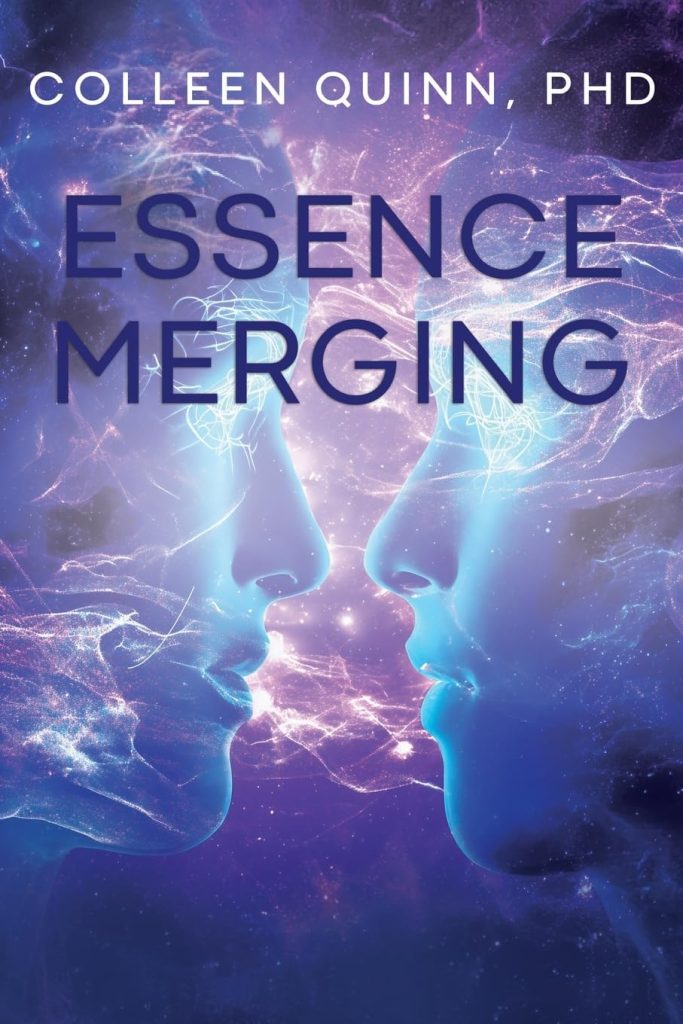
There’s a certain kind of book that doesn’t feel like it’s trying to teach you something.
It feels like someone is opening a door and saying, “This happened to me—come see if any of it is true for you.”
That’s what Essence Merging is.
And within the first few pages, you realize this isn’t going to be a clean, structured “spiritual framework” book. It’s something much messier—and more honest.
What This Book Actually Is
At its core, this is a spiritual memoir disguised as a transformation story.
Colleen Quinn isn’t presenting a system. She’s recounting a life that:
- Starts with psychological competence and outward success
- Breaks down through trauma, burnout, illness, and unresolved grief
- And then opens—sometimes abruptly—into experiences she interprets as direct encounters with love, consciousness, and something beyond the ordinary mind
The through-line is simple, but not simplistic:
Love is the only thing that matters—and the only thing that heals.
That idea shows up early and keeps deepening as the story unfolds.
Where It Pulls You In
What makes this book work is not the concepts—it’s the rawness.
You’re not reading about spirituality from a distance. You’re inside:
- A psychologist who feels like a fraud in her own field
A mother carrying unprocessed trauma
A woman confronting illness and the possibility of death
Someone watching her own mind turn against her
There’s a passage where she’s lying sick, waiting for test results, convinced her illness is some form of punishment. That inner dialogue—the critic, the guilt, the fear—it’s uncomfortable because it’s familiar.
And then something shifts.
Not intellectually. Not gradually. But through a moment of complete surrender:
“Help me be love in every moment… transform me.”
From there, the book changes tone. It becomes less about surviving life and more about entering it fully.

The Spiritual Turn (and Where Readers Will Divide)
The second half of the book moves into territory that will land very differently for different readers.
There are:
- Breathwork-induced altered states
- Energy centers (chakras)
- Encounters with shamans
- Experiences of light, vibration, and “life force”
If you’re open to that language—even a little—it can feel like an expansion.
If you’re not, this is where you may start to disengage.
But what’s interesting is that underneath all of it, the message doesn’t actually change. It just becomes more embodied:
- Stop living in your head
- Feel what you’ve avoided
- Let love—not fear—organize your life
Even the more esoteric experiences seem to point back to that same core.
What Stayed With Me
This isn’t a book that gives you neat takeaways. It leaves you with impressions.
A few that lingered:
- The idea that healing isn’t intellectual—it’s experiential
- The recognition that we can function at a high level while still being deeply disconnected from ourselves
- The uncomfortable truth that unprocessed pain doesn’t disappear—it gets stored
- And maybe most importantly: that love isn’t something you find—it’s something you become, or allow
There’s also a subtle but powerful thread running through the book:
the mind can either heal you or destroy you, depending on the story it tells
That’s not presented as theory—it’s lived out in real time.

Where It Falls Short
This is not a skeptical book.
It doesn’t question its own spiritual interpretations very much. Experiences are taken largely at face value, which means:
- Readers looking for grounded, evidence-based framing may struggle
- Some moments may feel exaggerated or overly certain
It’s also nonlinear at times—stories, insights, and backstory weave together in a way that mirrors how healing actually happens, but not how structured writing typically works.
And like many transformation narratives, there’s a risk of:
“this worked for me, therefore this is the path”
Even if that’s not explicitly stated.
Who This Book Is For
This will resonate most if you:
- Have done inner work (therapy, meditation, etc.) and feel like something is still missing
- Are open to spiritual language beyond traditional frameworks
- Have experienced burnout, grief, or a sense that your outer life doesn’t match your inner reality
- Are willing to sit with discomfort rather than analyze it away
If you’re purely analytical, this may frustrate you.
If you’re even slightly experiential, it may stay with you longer than expected.
My Take
This book doesn’t try to convince you.
It invites you into someone’s transformation, and then quietly asks:
“Where are you still holding back?”
It’s not polished in the traditional sense. It’s not balanced in a debate-oriented sense.
But it’s sincere—and that matters more here.
At its best, it feels like sitting across from someone who has gone through something real and is trying, as honestly as possible, to put words to it.
Recommendation
Read this if you’re willing to feel your way through it, not just evaluate it.
Don’t worry about agreeing with everything. You won’t.
Instead, notice:
- What resonates
- What irritates you
- What makes you pause
That’s where the value is.
Bottom Line (In Plain Terms)
This isn’t a book about understanding life better.
It’s about experiencing it more directly—and possibly more honestly—than you’re used to.
If you’re open to that, it’s worth your time.
 Colleen Quinn, PhD
Psychologist. Mystic.
Two-time near-death throwback.
Student of breath, devotion, and the sacred in all things.
I’ve been between worlds. I’ve walked the edge of this life.
What I found there changed everything.
Now, I write to remember.
Now, I write to in-spire.
Visit > Essence Merging
Leave a Reply